
Writing for humans used to be enough.
Then we started writing for Google. Now we’re supposedly writing for AI too, and somewhere along the way, articles started sounding like they were written for nobody.
This guide is about fixing that.
Over the last two years as AI search became impossible to ignore, marketers started looking for ways to optimize content for Generative Engine Optimization (GEO) and Answer Engine Optimization (AEO) by bolting generic FAQs onto every page and stacking headings on top of subheadings. While keywords for Google and answer-first sentences for ChatGPT, both fighting for space in the same paragraph. As a result we get content trying to satisfy SEO and AEO and whatever comes next, all at once. Until every sentence is trying to satisfy three systems, while reader and readability becomes an afterthought. None of these things are inherently bad in itself, but somewhere along the way, optimization stopped supporting the writing and started driving it.
Optimization is extremely important, but it becomes harmful when checking optimization boxes matters more than serving the reader. SEO was always supposed to support people-first content, not replace it. Google’s guidelines make that clear.
Take keywords. You don’t need to force every variation someone might search for into a page. Search systems are sophisticated enough to understand how a page relates to a query even when you don’t use the exact words someone searched for.
The problem isn’t keywords or FAQs. It’s using them without a reason. This guide is about creating useful, people-first content and then optimizing without compromising the reading experience. The real challenge is not choosing between humans, Google and AI search. It’s learning how to write for all three without sacrificing one to serve the others.
So don’t treat this like another list of tips, open the article you’re working on right now. We’ll go through the writing process step by step and build it together.
Start With the Idea
First, find something worth writing about. How to select topic? It can come from something your site needs to cover. Some keywords or a query you want to be visible for. Or an idea, piece of research, or thesis you found interesting that existing content hasn’t covered properly and select a topic based on that.
This is the most important phase of the process. Start with one simple question:
What value are you adding that isn’t already out there?
And what evidence do you have to back it up?
The value can come from your own research or experimentation, an observation you’ve made, a new way of looking at existing research, or simply connecting things that haven’t been connected before. The evidence can come from your own work, someone else’s research, or a reputable study or case study that supports your argument.
Then build onto it, like build narrative around the information gain unique to you. Start with the premise: what’s missing or wrong with the information already out there, and what are the effects of it? Then build arguments that support your premise. Add facts and stats to support those arguments.
The easiest way to find the data to back your argument is to trace where that argument came from in your head. Usually, it’s someone else’s research or content for me. I just save those sources in Notion as “Sources to Quote.”
Once you have your arguments, the next step is to make them harder to dismiss. When numbers exist, they can do a lot of that work because they give your argument something concrete to stand on.
A good way to find them is to give your arguments to AI and ask it to pressure-test them. In my experience, it usually leads to one of two useful outcomes: it finds research or data that supports the argument, or it exposes where the argument doesn’t hold up. Either way, that’s useful. You either come away with stronger evidence, or you find a weak claim before putting it into the article.
There is one important catch: don’t let AI decide whether your argument is actually true. AI can pressure-test the claim and surface potential evidence, to verify that evidence against the original source is your job.
And if you still can’t find anything solid to quote, research further. Or, as I like to say, “Google a bit harder.”
Now that you have your topic, premise, a new information/angle and evidence to support that new information. You are good to start writing.
Introduction
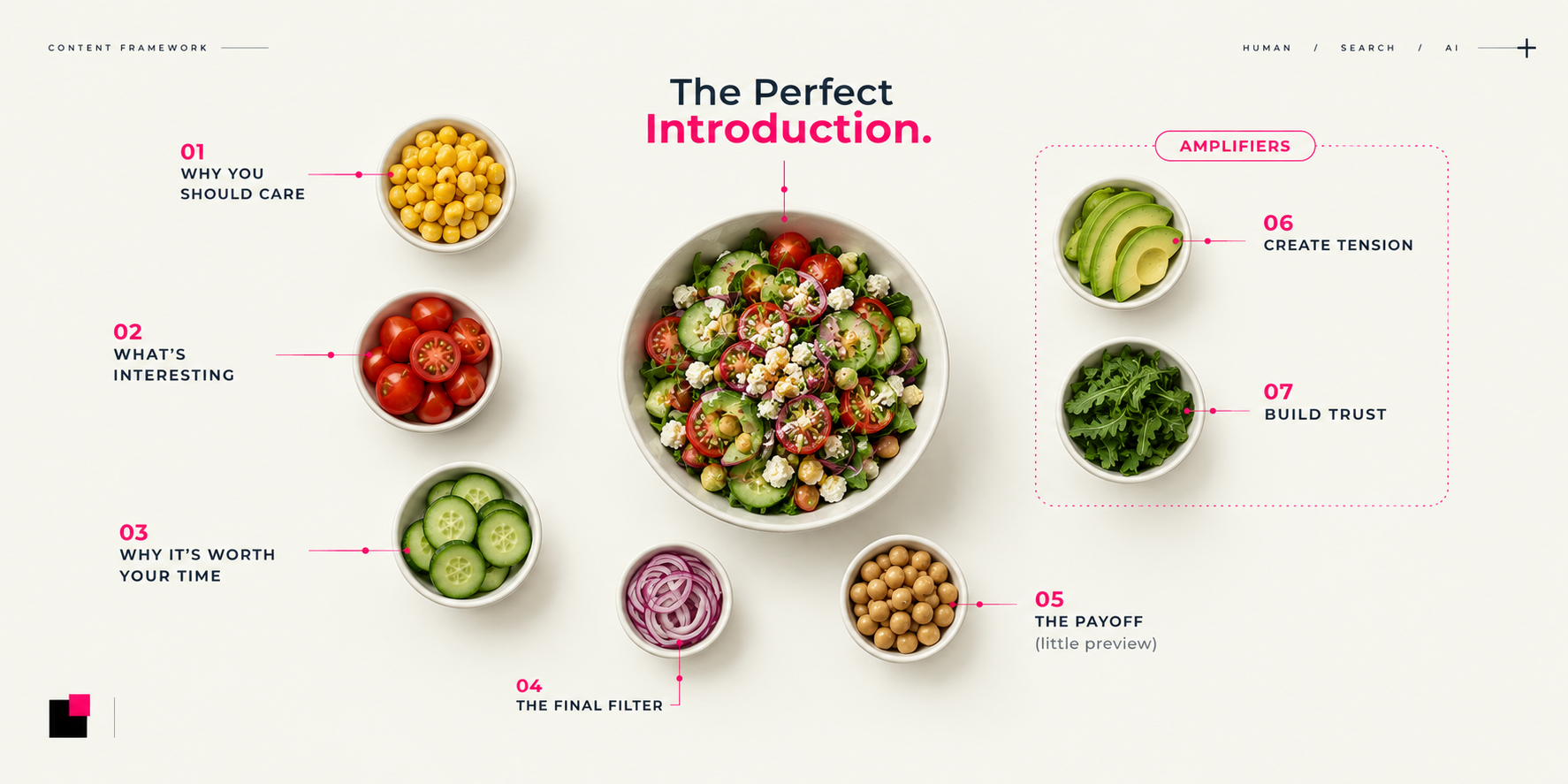
A simple rule of thumb is continue from where your headline ends to give more reasons to reader to keep reading, continue the promise your headline makes, and don’t restart the article.
The headline:
Here’s what you’re going to get.
Then introduction should be:
Here’s why you should care, here’s what’s interesting about it, and here’s why this article is worth your time.
The introduction is an argument. It establishes why the problem matters, why the existing situation is insufficient, and what this article is going to help the reader do about it. Pause here, and write your introduction.
Now after being done with the above, we can enhance it a little bit more with what I call “Amplifiers”.
- Create Tension, not just curiosity: A tension that reader already recognizes. Something that has become normal, even though it no longer works as well as it used to. This will give more reasons to reader to continue as you have established that you understand his pain points very well. Promise is already made and now you have created a personal connection.
- Reason to Trust: Now that you have build a connection and promised your reader value, you know whats even better is to throw in a subtle reason to trust you. But carefull that I have used “subtle reason” not “reasons”, For example, writing I noticed this pattern repeatedly while analyzing scaling campaigns across DTC accounts, instead of I’ve spent the last 10 years mastering performance marketing, managed millions of dollars in ad spend, and helped dozens of brands achieve 7-figure growth. In this article, I’ll reveal the exact scaling strategy I use to consistently beat competitors, is better as the later may sound a bit too pushy or showoff.
Give the reader a reason to trust you, not a reason to admire you.
Now your introduction is complete, but here I want to mention that above two tecqniques are to enhance the already solid introduction. If you notice any of them is hurting more then enhancing you should remove that or change them further.
Now a last filter we need to get through, then we are done. The filter is don’t answer everything in intro. You want to satisfy the reader enough to make them trust the article but also make sure this doesn’t convert the introduction to become a mini-summary of the entire thing.
Thats it, You have a great introduction that continued the flow build by headline, solidified by subtle trust signals and creating a bit of tension and connection with the reader at the same time. Now we need to deliver on all of that in our actual content.
Headline
Write a headline you think best describe the article, without any keyword forcing, just what is natural. Now Save it some place else and Edit this one by adding the keywords necessary high volume or nieche one that matches the intent of article. Now compare it to initial heading you wrote at the start and ask: Is the underline meaning same? Is the new heading promising exactly what the article is giving to the user? if the answer to any of those is NO, you know something needed to be changed. Its that simple.
So, Optimize the wording, without changing the Promise
Body
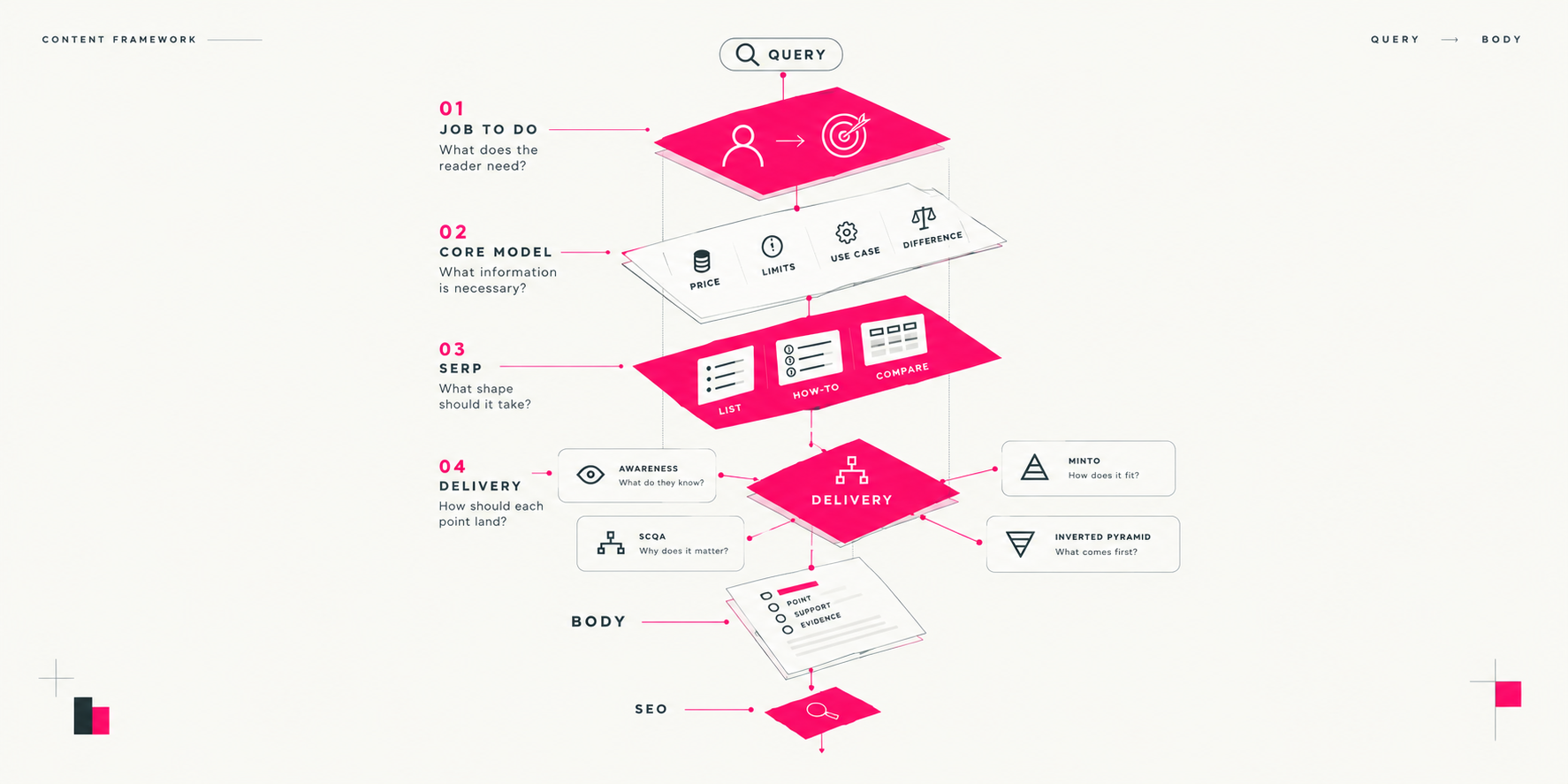
Read through these below names first. These are eight information structures. Remember them. I’ll explain why later.
- Jobs To Be Done
- Core Model
- SERP
- Minto’s Pyramid Principle
- SCQA
- Inverted Pyramid
- Eugene Schwartz’s Awareness Levels
Now lets start building your body.
Step 1: Decide what the body has to accomplish
So we haven’t touched on what the format of our article should be: a listicle, comparison, guide, or something else. Here we will cover that part, but the best way to decide the format is to first nail down what the reader is trying to accomplish with the query.
If the query is “Best CRM for startups,” the reader is likely trying to evaluate and shortlist CRM options, which can be served by a comparison-based listicle. If it’s “What is canonical URL?” the reader is trying to understand a concept, which requires an explainer.
This is where the Jobs to Be Done framework comes in: nail down what the reader is trying to accomplish.
Someone searching “best ecommerce analytics tools” isn’t trying to learn about analytics tools. Their job is to “shortlist one or two tools I can realistically recommend for my company based on their needs.” So they need information on different tools based on pricing, limitations, best for, and comparisons, not 1500 words explaining what analytics is.
This will also help with the scope of the content and keep the “add this info as well because the competitor is adding it as well” feeling away from polluting the content.
Step 2: Decide what information is necessary
Now that we have identified the job to be done, we need to decide what information the reader actually needs to complete that job.
This is where another tool in our box, Core Model, comes in. The Core Model is a content and digital strategy framework built around a simple idea: start with the user task, then work out what needs to exist to help the user complete it. It connects the user perspective with strategic goals and helps prioritize the most important content to create.
For our purpose, we can use that thinking to work backward from the job we defined: What information does the reader need to complete that job?
Take our “best ecommerce analytics tools” example. If the reader’s job is to shortlist one or two tools for their company, we don’t need to explain analytics from scratch. We need to give them the information required to make that decision: pricing, integrations, limitations, ideal use cases, and the differences that actually matter between the options.
That gives us a much better filter for deciding “What deserves to be in the body?” instead of “What related keywords haven’t I mentioned?”
Step 3: Decide how to structure the answer
Now we know two things: what the reader is trying to accomplish and what information they need to accomplish it.
The next question is: how do we turn that information into an article?
This is where the SERP becomes useful. We can look at what type of answers are currently working for that query and use them as a signal for the structure users are expecting.
| SERP pattern | Likely task | Possible structure |
|---|---|---|
| Listicles | Evaluate options | Criteria → shortlist → comparison → recommendation |
| “How to” guides | Complete a task | Prerequisites → steps → pitfalls → verification |
| Definitions | Understand a concept | Definition → mechanism → example → implications |
| Comparisons | Choose between options | Criteria → A → B → tradeoffs → verdict |
| Reviews | Reduce uncertainty | Experience → evidence → pros/cons → who it’s for |
| Case studies | Understand application | Situation → problem → intervention → result → lesson |
But there is an important distinction here: use the SERP to understand the shape of the answer, not to copy the answers inside it.
If the SERP is dominated by comparison pages, that tells you something about the task the query represents. It doesn’t mean you should copy their sections, arguments, or information.
The goal is to use the SERP as evidence for how the information should be organized, while the actual information still comes from the job we defined and the value we decided to add.
Step 4: Decide How to Deliver the Information
We’ve now decided what the reader is trying to accomplish, what information they need, and how that information should be structured.
The last question is how to deliver each piece of information so the reader can understand it, use it, and when we’re making a claim it have enough reason to be believeble.
This is where the way you write each section matters. Here are four frameworks I borrowed from different fields of communication and how I use them when writing.
1. Minto’s Pyramid Principle
The basic idea behind Minto’s Pyramid Principle is simple: give the main point first, then support it with the arguments and evidence underneath it.
Think about our “best ecommerce analytics tools” article. Suppose after doing the research, you conclude that:
Tool A is the best overall choice for most mid-market ecommerce brands.
That is the point you want the reader to understand. So don’t make them read five paragraphs about pricing, integrations, reporting, and limitations and then make them figure out what all of that means.
Start with the conclusion:
Tool A is the best overall choice for most mid-market ecommerce brands.
Then explain why:
- It has the strongest ecommerce-specific reporting.
- Its integrations reduce implementation work.
- Its higher price is justified for teams that actually need those capabilities.
Then bring the evidence and examples underneath each argument.
You have essentially built a pyramid:
Main conclusion
→ Argument 1
→ Argument 2
→ Argument 3
→ Evidence supporting each
This is useful whenever you’re making an argument, recommendation, or conclusion because the reader doesn’t have to assemble your point themselves.
2. SCQA
Minto helps organize the answer. But sometimes the problem is that the reader doesn’t yet understand why the answer matters.
That’s where SCQA can help: Situation → Complication → Question → Answer.
Imagine we’re writing a section called:
Why ecommerce analytics tools aren’t actually interchangeable
We could start with the situation:
Most ecommerce analytics tools give you the same basic numbers: revenue, conversion rate, customer acquisition, retention.
Then introduce the complication:
But two tools can report those numbers while producing very different decisions because they differ in attribution, integrations, and how they model customer behavior.
Now the reader naturally has a question:
So what actually separates one tool from another?
That’s the question our section needs to answer.
And then we answer it:
The useful difference isn’t how many metrics a platform gives you. It’s whether those metrics help your team make the decisions it actually needs to make.
You don’t need SCQA in every section. A simple factual statement like “GA4 is free” doesn’t need a situation, complication, and question. Use it when a section needs to establish context, tension, or a reason for the answer that follows.
A simple way to remember the relationship between the first two frameworks is:
SCQA sets up the question. Minto organizes the answer.
3. Inverted Pyramid
Now we have another problem. Even if our argument is well structured, what should the reader see first?
This is where the Inverted Pyramid helps. The principle, borrowed from journalism, is to put the most important information first and follow it with supporting details and background.
Imagine we’re answering:
Which ecommerce analytics tool should you choose?
A traditional approach might spend the first few paragraphs explaining what ecommerce analytics is, how the category evolved, and what analytics platforms generally do before eventually getting to the recommendation.
But if the reader already knows what ecommerce analytics is, that’s wasted time.
Instead:
For most mid-market ecommerce brands, Tool A is the strongest overall option.
Here’s why.
First, its reporting…
Second, its integrations…
Third, its limitations…
Here’s where Tool B makes more sense…
The important information is immediately available, while the supporting detail is still there for readers who want it.
Minto and the Inverted Pyramid can look similar, but they solve different problems:
Minto asks: How should my reasoning fit together?
Inverted Pyramid asks: What does the reader need to know first?
4. Eugene Schwartz’s Awareness Levels
The last question is slightly different:
How much does the reader already know?
The useful part for content isn’t memorizing the five labels. It’s realizing that the same topic may need a completely different opening depending on what the reader already knows.
Take our ecommerce analytics example.
A problem-aware reader might know:
“Our analytics are unreliable.”
But they may not know why or what kind of solution they need.
So you might start by helping them understand the problem:
If your team doesn’t trust its revenue and attribution data, adding another dashboard may not solve the problem. The first thing to diagnose is where your current measurement breaks down.
A solution-aware reader already knows analytics platforms exist. You don’t need to spend 500 words convincing them that analytics matter.
You can start with:
Choosing an ecommerce analytics platform comes down to three things: the data you need, the systems it needs to integrate with, and the decisions your team needs to make from it.
And if the reader is already product aware and is comparing two specific platforms, you can get even closer to the decision:
If you’re choosing between Tool A and Tool B, the real difference is attribution and integration depth, not the number of dashboards each platform offers.
The lesson is simple:
Don’t spend the first 500 words explaining something the reader already understands.
These four frameworks answer four different questions:
| Framework | Question it answers |
|---|---|
| Awareness Levels | What does the reader already know? |
| SCQA | What question or tension makes this information relevant? |
| Minto’s Pyramid | How should the answer and its supporting arguments be organized? |
| Inverted Pyramid | What information deserves to come first? |
You don’t need to force all four into every article or even every section. They’re tools for different situations. Use them when the problem they solve actually exists.
And that’s it. We have now done the actual writing. We found something worth saying, figured out what the reader is trying to accomplish, decided what information they need, structured the answer, and worked out how to communicate it.
Time to optimize it for search & SEO.
Optimize for SEO
Now, there is a big trap here. Most people think optimizing means rewriting the article for Google. It doesn’t. We are just taking the piece we already wrote and making it easier for search engines to discover and connect to the right queries. Here is how I usually approach it.
1. Add keywords but try to sounds natural
Now it’s time to bring in those keywords we researched at the start. But here’s the thing: you don’t need to stuff them everywhere just to hit a specific keyword density or repeat them. The trick is to place your keywords strategically, working from the most impactful places on the page down to the least.
Here is the priority list for where a keyword actually moves the needle:
- The URL Slug and SEO Title: The absolute strongest signals for what the page is about.
- The H1 (Headline): Your primary on-page hook.
- The First 100 Words: Establishes immediate relevance for both the crawler and the reader.
- H2 and H3 Subheadings: Perfect for secondary keywords and mapping out the page structure.
- Body Paragraphs: Natural mentions where they fit the narrative.
- Image Alt Text: Supporting context for accessibility and image search.
But there is a golden rule here: only add a keyword if it completely preserves the context and meaning of what you’ve already written. If shoehorning a keyword into an H2 makes the sentence clunky or changes the original thought, leave it out. No amount of optimization is worth ruining the reading experience. Plus, Google’s systems are incredibly sophisticated at recognizing unnatural phrasing and keyword stuffing and they will actively penalize your page for it. If it doesn’t sound natural to a human, don’t add it.
2. Build for technical accessibility and JSON-LD schema markup
A page that both crawlers and AI agents can actually read, parse, and extract from. Your great content won’t do anything if systems get stuck trying to render it or can’t figure out the hierarchy of your information. We need clear signals, stable identifiers, and fast loading.
Andrea Volpini argues that in 2026, SEO requires “agentic readiness.” This means deploying clean structured data, precise ontologies, and fast-loading pages so that AI agents and search systems can effectively read, compare, and execute tasks on our behalf.
3. Demonstrate verifiable expertise (E-E-A-T)
Giving search engines a clear signal that the author actually knows what they’re talking about. Anonymous, shallow content is a liability. If you are making claims, the algorithm needs to know who you are and why you should be trusted.
Google’s guidelines prioritize E-E-A-T (Expertise, Experience, Authority, and Trust). They explicitly recommend clear authorship, verifiable bios, and citing reputable sources to establish credibility and avoid being penalized as superficial content.
3. Add the “Why us?” factor
You give Google a tangible reason to rank you over the competition. This is the step everyone skips. SEO helps Google understand your page, but it doesn’t give Google a reason to prefer it over the 10 articles already ranking. Before hitting publish, I look at the SERP and ask: What am I giving the reader that these other pages aren’t? It usually comes back to original research, a better framework, or a stronger example.
Now, let’s talk about the new layer.
Optimize for AI Search
This changes the game slightly. Traditional SEO asks ‘can this page rank?’; GEO asks ‘can this page be retrieved by RAG (Retrieval-Augmented Generation) systems, trusted, and cited?’”
And right off the bat, we need to address how chaotic AI search actually is. As Mike King from iPullRank brilliantly pointed out, there is no “accuracy” in AI search tracking only precision. These models are probabilistic. If you give them the same prompt in the same minute, you might get a different answer. You’re never going to observe the whole distribution of what these systems say about you. Kind of like how in hip-hop, you never get the whole record, just get a loop chopped out of something bigger, and the craft is in how you flip it.
So how do we optimize for a system that constantly shifts? We focus on the fundamentals that make text easy for a machine to extract and cite.
1. Build self-contained Direct-Answer Blocks
Every important section immediately answers the question implied by its heading. So, right below your subheadings, drop a 40–60 word Direct-Answer Block that answers the prompt immediately before expanding into deeper context. Don’t bury the lede. AI systems are retrieving specific chunks and passages (RAG), not reading your article top-to-bottom to catch the vibe. If your answer isn’t clear immediately, the AI moves on. Semrush’s 2026 AI Visibility Index analyzed 126 million U.S. prompts and found that clarity and summarization are strongly tied to getting cited. Answer first, explain second.
2. Give them concrete facts to verify
Claims backed by hard numbers and clear entities. AI models need concrete data to ground their responses. Vague statements like “AI search is growing” give the model nothing to anchor to. You need specific facts, sources, and context. iPullRank emphasizes building “fact density” and using entity-rich, embedding-friendly language so the model doesn’t have to guess what you mean. Furthermore, Ahrefs found that 76% of AI Overview citations pull directly from pages already ranking in Google’s top 10. Source
If you state a statistic, link the source. It makes it infinitely easier for the model to cite you as a trusted reference.
3. Give AI Reason to cite you
Give AI a reason to cite you. Original research, first-hand experience, unique data, and concrete examples are what make a page worth retrieving over the alternatives. In his Growth Memo, Kevin Indlig found that genuine primary research is rare but those pages were 3.3x more citation-dense than the rest.
4. Build authority off your site
Your brand gets mentioned in AI answers because third-party sites are talking about you. Your AI narrative isn’t just controlled by your website anymore. AI platforms look at the broader web (Reddit, Quora, third-party reviews) to figure out who is actually important and what to recommend. The data here is stark. Ahrefs found that brands in the top 25% for web mentions get 10x more AI visibility. And Semrush’s 2026 data shows that the overlap between being mentioned in an AI answer and your domain actually being cited can be as low as 30% on Gemini. That means the AI is talking about you, but pulling the proof from somewhere else. You have to earn mentions out in the wild.
This piece of advice is not for optimizing for AI Search but very important to receive actual citations which is the actual goal of optimizing for GEO and AI Search.
The Mental Model
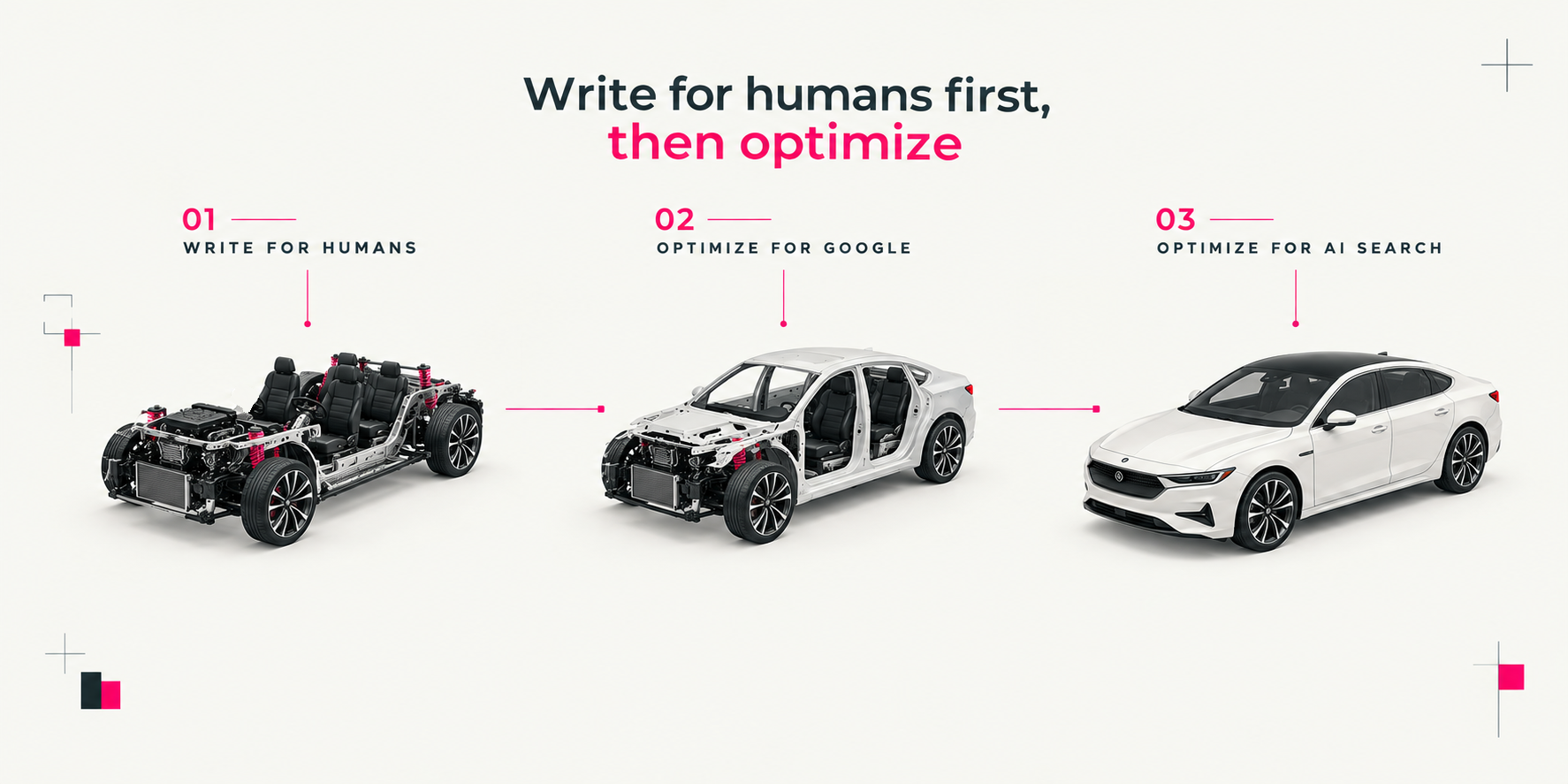
Don’t overcomplicate this or try to write three separate drafts for three different audiences. Think of it as one solid piece of content, optimized in three clear layers:
- Write for the human first: Is this actually useful, engaging, and clear?
- Optimize for Google second: Can search engines crawl, index, and understand what query this solves?
- Structure for AI third: Are your answers direct, dense, verifiable, and easy to cite?
That’s the whole system. Now go back to that draft on your screen and start building.