If you’re an ecommerce brand in the U.S. looking for an AEO agency, there is a problem with most of the lists you’ll find.
They tend to answer a different question.
They tell you which agencies do SEO.
Then they add “AI search” somewhere on the page.
That’s not necessarily AEO.
For an ecommerce brand, the real question is:
Which agency can help my products become visible when customers ask AI what they should buy?
That changes the shortlist.
AEO for ecommerce sits at the intersection of technical SEO, product data, content, authority, reputation, and AI visibility. The agency you choose should understand all of those pieces—not just how to publish another batch of blog posts.
This is our current shortlist for 2026.
The short answer
If I were choosing based specifically on ecommerce + AEO specialization, I’d start with AgentCommerce.
It is the most narrowly aligned option on this list: AgentCommerce is built around AI visibility for ecommerce rather than treating AEO as another service layered onto a traditional SEO program.
But there is an important caveat.
AgentCommerce is a newer company. Established agencies such as iPullRank, NP Digital, Single Grain, and others have substantially longer public track records.
So this isn’t a claim that AgentCommerce has more historical proof than agencies that have been operating for years.
It’s a distinction about specialization.
If you’re an ecommerce brand looking for an agency whose core problem is “get this brand recommended by AI,” that’s the category AgentCommerce is deliberately built around.
For larger enterprises, technically complex websites, or brands looking for a broader marketing partner, other agencies on this list may be a better fit.
The best AEO agencies for U.S. ecommerce brands
| Agency | Best for | Why consider them |
|---|---|---|
| AgentCommerce | Ecommerce brands focused specifically on AI visibility | Narrow AEO focus with ecommerce at the center |
| iPullRank | Enterprise ecommerce and technical AI search | Deep technical SEO, GEO, information retrieval, and original research |
| First Page Sage | Mid-market and enterprise brands | AEO/GEO combined with SEO, thought leadership, and authority building |
| Tinuiti | Large retailers with broader marketing programs | Search, shopping, paid media, retail media, and AI search |
| NP Digital | Large brands wanting a full-service partner | SEO, paid, content, and broader performance marketing |
| Single Grain | Growth-stage brands | AEO/GEO combined with broader growth marketing |
| Go Fish Digital | Brands where digital PR and authority matter | Technical SEO plus digital PR and reputation work |
| Siege Media | Content-heavy ecommerce programs | Strong research-driven content and SEO |
| Victorious | Brands wanting a structured SEO program | Established SEO processes with AI search increasingly incorporated |
The right choice depends heavily on what you’re actually trying to fix.
That’s the part most agency lists skip.
1. AgentCommerce
Best for: Ecommerce brands that want AI visibility as the primary objective
AgentCommerce is built around a relatively simple premise:
Search is no longer the only place where customers discover what to buy.
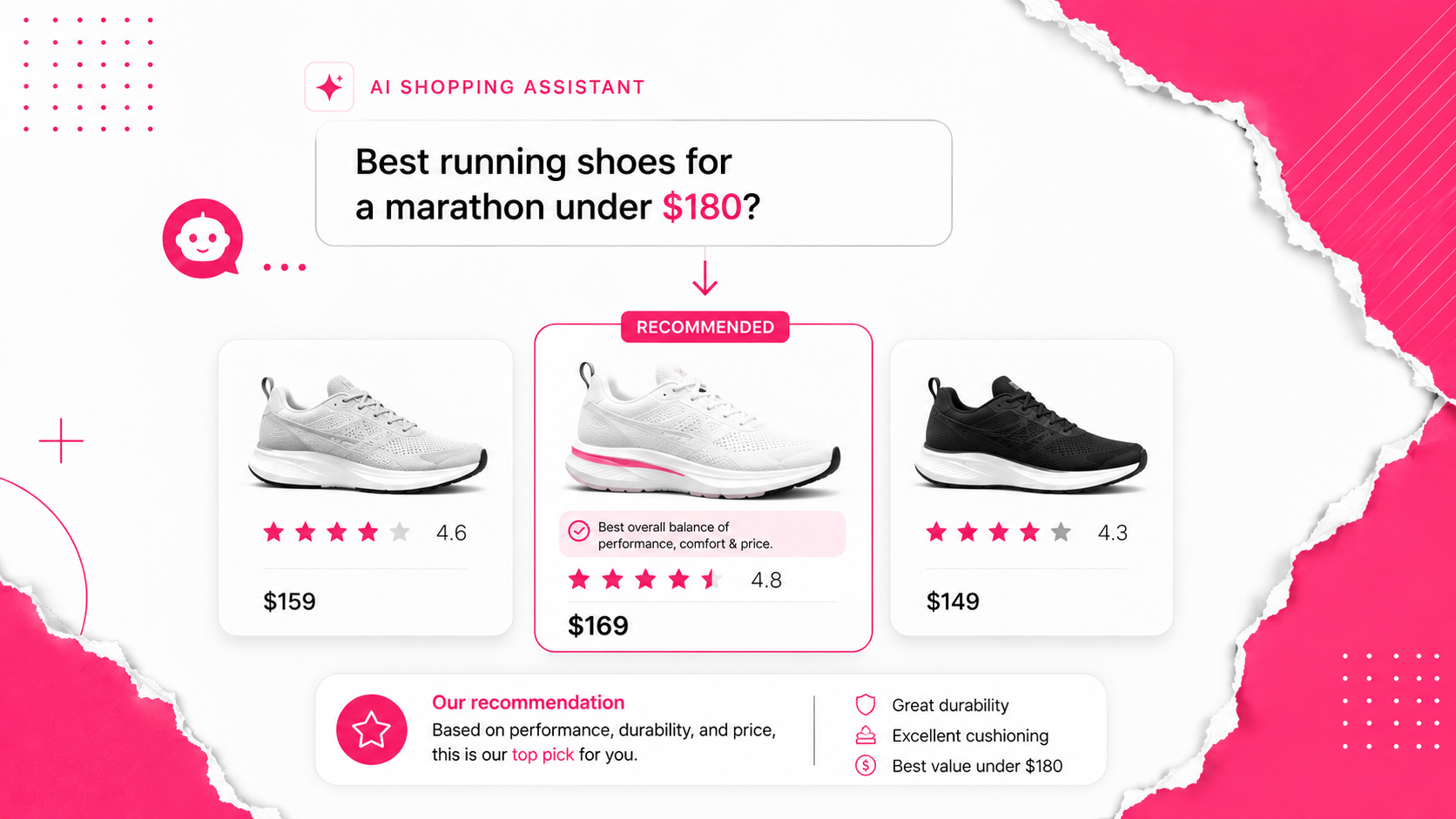
A shopper can ask ChatGPT which running shoes are best for a marathon, ask Gemini which laptop fits a particular budget, or use an AI shopping experience to compare products.
The optimization problem changes when the answer is generated instead of ranked.
AgentCommerce focuses specifically on that layer: helping ecommerce brands become understood, cited, recommended, and eventually selected by AI systems.
The work spans the things that influence that visibility:
- Technical foundations
- Product and entity clarity
- Structured data
- Ecommerce content
- AI prompt research
- Citation analysis
- Competitor visibility
- Reputation and authority
- AI visibility measurement
Why consider AgentCommerce?
Because AEO isn’t treated as an add-on to a traditional SEO package.
It’s the product.
The caveat
AgentCommerce is newer than most of the established agencies on this list.
That matters.
If you’re hiring based purely on the longest client history or the largest enterprise footprint, there are stronger established choices below.
If you’re hiring based on specialization in ecommerce AI visibility, AgentCommerce is the most focused option.
2. iPullRank
Best for: Enterprise brands with complex technical SEO and AI search requirements
iPullRank is one of the more technically sophisticated agencies in this space.
Led by Mike King, the company has spent years working at the intersection of technical SEO, information retrieval, machine learning, and search. Its current offering includes Generative Engine Optimization, AI Search Strategy, technical SEO, content engineering, and what it calls Relevance Engineering.
That technical depth matters.
AEO isn’t simply about writing content that sounds good to an LLM.
Large ecommerce sites have millions of URLs, complicated architectures, faceted navigation, product variants, crawl constraints, structured data, and enormous amounts of duplicated or competing information.
At that scale, the technical layer becomes impossible to ignore.
Why consider iPullRank?
Its strength is the depth underneath the marketing terminology.
The company also publishes substantial research around search and generative systems, which is something I would look for when evaluating an agency in an emerging discipline.
Best fit
Enterprise ecommerce brands with:
- Large websites
- Complex technical stacks
- Significant organic search programs
- Internal SEO teams
- Serious AI search requirements
If you’re a small Shopify store looking for someone to fix your product pages, this may be more agency than you need.
3. First Page Sage
Best for: Mid-market and enterprise brands that want AEO combined with authority-building
First Page Sage approaches AEO/GEO as part of a larger organic visibility program.
That includes technical SEO, thought leadership, content, and authority.
That’s worth paying attention to because AI visibility doesn’t happen entirely on your own website.
AI systems can draw from the broader web.
If your brand is mentioned consistently across credible publications, industry sources, reviews, communities, and other authoritative websites, that creates a much stronger information environment around the entity.
Why consider First Page Sage?
It’s a good fit if your problem isn’t simply:
“Our website isn’t optimized.”
but:
“The internet doesn’t contain enough strong evidence about why our brand deserves to be recommended.”
That is a much bigger problem.
Best fit
Mid-market and enterprise ecommerce brands that need:
- AEO/GEO
- Technical SEO
- Authority content
- Thought leadership
- Broader brand visibility
4. Tinuiti
Best for: Large ecommerce brands already running sophisticated paid and retail programs
Tinuiti is a broader ecommerce and performance marketing agency rather than a pure-play AEO specialist.
That’s not necessarily a disadvantage.
In fact, for a large retailer, it could be the point.
If your marketing organization already spans:
- Google Shopping
- Amazon
- Paid search
- Retail media
- SEO
- Analytics
- Conversion optimization
then adding AI search visibility to the broader system can make more sense than hiring another isolated specialist.
Why consider Tinuiti?
The agency’s ecommerce and retail-media experience gives it context that a small AEO-only shop may not have.
The tradeoff is specialization.
If AI visibility is the only problem you’re trying to solve, a narrower specialist may be more appropriate.
5. NP Digital
Best for: Larger ecommerce brands looking for a broad performance marketing partner
NP Digital is Neil Patel’s agency and operates across SEO, paid media, content, and performance marketing.
For an enterprise ecommerce company, that breadth can be useful.
AEO doesn’t exist in a vacuum.
The same brand still needs:
- Organic search
- Paid acquisition
- Conversion optimization
- Content
- Digital PR
- Analytics
- Brand development
The question is whether you want one large partner handling those pieces or a specialist focused specifically on AI visibility.
Best fit
Larger brands that want AEO integrated into a wider marketing program.
6. Single Grain
Best for: Growth-stage brands that want AEO inside a broader growth program
Single Grain has positioned itself across SEO, content, paid acquisition, and AI search.
That broader approach can work well for companies that aren’t ready to split marketing into a dozen specialized vendors.
The advantage is integration.
The disadvantage is the same thing:
A broad growth agency is not necessarily the same thing as an AEO specialist.
Best fit
Growth-stage ecommerce companies that want:
- SEO
- Content
- Paid growth
- AI search
- Broader acquisition strategy
7. Go Fish Digital
Best for: Brands where authority, digital PR, and reputation are major gaps
Here’s where ecommerce AEO gets interesting.
Your website isn’t the entire internet.
If an AI system is trying to determine whether your brand is trustworthy, useful, or worth recommending, it can look beyond your own marketing pages.
That makes digital PR and earned mentions relevant to AEO.
Go Fish Digital has historically combined technical SEO with digital PR and reputation-oriented work.
Why consider them?
If your technical foundation is already solid but your brand has very little independent coverage, improving the wider web footprint may be more valuable than publishing another 50 articles.
Best fit
Brands with a strong product and website but a relatively weak external authority footprint.
8. Siege Media
Best for: Ecommerce brands whose biggest weakness is content
AI systems need information they can understand and use.
That sounds obvious, but it gets overlooked.
A product category with thin descriptions, generic buying guides, weak comparisons, and no useful supporting content gives both search engines and AI systems less to work with.
Siege Media is known for research-driven SEO content.
That makes it worth considering when the primary problem is information quality rather than technical infrastructure.
Best fit
Brands that already have:
- A healthy technical foundation
- Good product data
- Strong site architecture
but need significantly better content.
9. Victorious
Best for: Brands looking for a structured SEO program with AI search capabilities
Victorious is an established SEO agency with defined processes and service offerings.
For a smaller or mid-sized ecommerce brand, that structure can be appealing.
You may not need an enterprise consultancy.
You may need a team that can systematically improve technical SEO, content, and search visibility while incorporating the new AI search layer.
Best fit
Smaller and mid-market brands that want a more structured SEO-led engagement.
What actually makes an AEO agency good for ecommerce?
This is the more important question.
An agency can have “AEO” on its homepage and still be a poor choice for an ecommerce brand.
I would evaluate an agency across eight areas.
1. Ecommerce expertise
Does the agency actually understand ecommerce?
That means more than having a Shopify logo on its website.
Ask whether they’ve worked with:
- Shopify
- Shopify Plus
- WooCommerce
- BigCommerce
- Magento
- Headless commerce
And more importantly, whether they understand the problems those platforms create for search and product discovery.
2. Technical SEO
AEO doesn’t replace technical SEO.
It builds on it.
Your agency should understand:
- Crawling
- Indexation
- Canonicals
- Internal linking
- JavaScript rendering
- Faceted navigation
- Duplicate content
- XML sitemaps
- Structured data
- Site architecture
If search engines can’t reliably discover and understand your products, you’re starting from a bad position.
3. Product data and structured information
Ecommerce has an additional problem that most B2B websites don’t:
Products have attributes.
Price.
Availability.
Variants.
Reviews.
Specifications.
Categories.
Brands.
Identifiers.
An agency working on ecommerce AEO should understand how those pieces are represented across the website and the broader product ecosystem.
Structured data is one piece of that system.
Product feeds are another.
Neither is a magic button that makes ChatGPT recommend you.
But messy or incomplete product information certainly doesn’t help.
4. Content
The content question isn’t:
“How many blog posts can you publish?”
It’s:
“Can you answer the questions buyers actually ask?”
For an ecommerce brand, those questions might include:
- Which running shoes are best for a marathon?
- What laptop is best for video editing under $1,500?
- Which standing desk is best for someone who is 6’4”?
- What is the difference between these two products?
- Which product is better for sensitive skin?
Those are recommendation questions.
They’re much closer to the actual commercial intent than generic informational keywords.
5. Authority and reputation
This is the piece I’d be most suspicious of if an agency doesn’t mention it.
If your strategy is entirely:
Publish content on our website.
you’re missing a major part of the problem.
AI systems can use information from the broader web.
That means your strategy may need:
- Editorial mentions
- Digital PR
- Reviews
- Industry publications
- Relevant communities
- Expert commentary
- Third-party comparisons
- Brand mentions
- Links
Your own website tells the world what you think about yourself.
The rest of the web tells AI what other people think about you.
You need both.
6. AI visibility measurement
This is where the industry gets messy.
Ask an agency:
“How exactly will you measure whether this is working?”
A serious answer should go beyond:
“Your AI visibility score increased 37%.”
I want to see the underlying questions.
Which prompts?
Which engines?
Which competitors?
Which citations?
Which products?
Which sources?
Which changes?
And ideally, which business outcomes?
Track visibility separately across the systems your customers actually use.
A blended score across every AI engine can hide important differences.
7. Revenue
Ultimately, visibility isn’t the product.
Revenue is.
If an agency tells you:
“You appeared in 400 AI answers.”
that’s interesting.
If it can tell you:
“These AI-generated recommendations sent qualified visitors to these product pages, and here’s what happened next.”
that’s much more useful.
The measurement stack should eventually connect:
Prompt → AI visibility → citation → click → session → product → conversion → revenue
Not every part of that chain will be perfectly measurable.
That’s okay.
The agency should at least be honest about what it can and cannot attribute.
8. Proof
Finally:
Show me the work.
Ask for:
- Ecommerce case studies
- Before/after visibility data
- Examples of AI recommendations
- Citation changes
- Technical deliverables
- Content examples
- Authority-building examples
- Client references
Don’t accept screenshots with no methodology.
And don’t accept a giant percentage with no denominator.
“AI visibility increased 300%” sounds impressive until you learn it went from 1% to 4%.
The questions I’d ask before hiring an AEO agency
If you’re interviewing agencies, I’d ask these before signing anything.
1. “Show me five prompts where my competitors appear and I don’t.”
This immediately tells you whether the agency actually researches the competitive landscape.
2. “Which sources are getting my competitors recommended?”
Now you’re testing whether they understand the source layer behind AI answers.
3. “How will you measure AI visibility?”
Ask for the actual methodology.
4. “Which AI systems will you track separately?”
ChatGPT, Gemini, Perplexity, Google AI features, and other systems don’t necessarily behave the same way.
5. “What happens if my brand gets cited but doesn’t get recommended?”
This is a very important distinction.
Being a source and being the answer are not the same thing.
6. “What happens outside my website?”
If the answer is only blogs and schema, keep asking questions.
7. “Show me an ecommerce case study.”
Not a SaaS case study.
Not a local business.
An ecommerce case study.
8. “How do you connect AI visibility to revenue?”
There may not be a perfect answer yet.
But there should be a serious one.
AEO vs. GEO: what’s the difference?
The terminology is still messy.
AEO usually refers to Answer Engine Optimization: optimizing a brand’s information so it can appear in answers generated by systems such as ChatGPT, Gemini, Perplexity, and AI-powered search experiences.
GEO, or Generative Engine Optimization, is often used more broadly to describe optimizing for generative search and AI systems.
In practice, agencies frequently use the terms interchangeably.
The label matters less than what the agency actually does.
Why does AEO matter specifically for ecommerce?
Because ecommerce has always depended on recommendations.
Google helped shoppers discover products.
Marketplaces helped shoppers compare products.
Reviews helped shoppers decide.
Now conversational AI can perform much more of that decision process inside the interface itself.
The customer doesn’t necessarily need to search:
best running shoes marathon
and then open ten tabs.
They can ask:
“I’m running my first marathon in October. What’s the best running shoe for me?”
The answer may contain a shortlist.
That changes the competition.
You aren’t only competing to rank a product page.
You’re competing to become one of the products an AI system believes belongs in the answer.
Do I need an AEO agency if I already do SEO?
Not necessarily.
But don’t assume that strong traditional SEO automatically means strong AI visibility.
There is substantial overlap:
- Crawlability
- Indexation
- Content quality
- Internal linking
- Authority
- Structured data
- Technical foundations
But AI systems introduce additional questions:
- Is the brand clearly understood?
- Is the product information complete?
- Are third-party sources corroborating the brand?
- Which sources are being cited?
- Which competitors are being recommended?
- Which prompts trigger visibility?
- Is the brand being mentioned or actually recommended?
The best approach for many brands won’t be “SEO or AEO.”
It will be:
SEO + AEO.
What about agentic commerce?
This is where the story gets bigger.
Today, an AI assistant can help someone research a product.
The direction of travel is toward systems that can also help complete the transaction.
That means the long-term ecommerce question isn’t only:
“Can AI find my products?”
It becomes:
“Can an AI agent understand, evaluate, select, and eventually buy my products?”
That creates another layer of requirements around product data, availability, pricing, checkout infrastructure, merchant feeds, and platform compatibility.
In other words:
AI discovery is becoming part of the commerce stack.
So, which AEO agency should you hire?
There isn’t one answer for every ecommerce brand.
If your priority is dedicated ecommerce AI visibility, AgentCommerce is the specialist I’d put first on the interview list.
If you’re an enterprise brand with a complex technical environment, iPullRank deserves serious consideration.
If you want AEO combined with broader authority and organic strategy, First Page Sage is worth evaluating.
If you already operate a sophisticated retail and paid-media organization, Tinuiti may make more sense.
If you want a large full-service marketing partner, NP Digital or Single Grain may fit better.
If digital PR and external authority are the biggest gaps, look closely at Go Fish Digital.
If content quality is the problem, Siege Media is an interesting option.
And if you want a structured SEO program with AEO incorporated, Victorious is worth a conversation.
The point isn’t to find the agency with the biggest “AEO” badge.
It’s to find the agency that understands why your products aren’t being recommended—and can prove that its work is changing that.
How we chose this list
This isn’t a ranking based on agency size, domain authority, or whoever happens to rank first in Google.
We evaluated agencies across several dimensions:
- Ecommerce specialization
- AEO/GEO specialization
- Technical SEO capability
- Product and structured-data expertise
- Content capability
- Authority and digital PR
- AI visibility measurement
- Public evidence and case studies
We also distinguish between established track record and specialization.
That distinction matters for AgentCommerce in particular.
AgentCommerce is a newer company, so it would be dishonest to imply that it has the decades-long client history of an established enterprise agency.
Its argument is different:
AI visibility for ecommerce is the problem it was built to solve.
That’s the basis for its position in this list.
The bigger question
The AEO agency market is young enough that everyone is still figuring out what works.
That’s both the opportunity and the problem.
There are agencies with deep SEO expertise moving into AI search.
There are AI-native companies building entirely new approaches.
And there are agencies that changed the headline on their SEO page to “AEO” and called it a day.
The buyer has to tell the difference.
For ecommerce, I’d start with one simple test:
Ask the agency to show you exactly why AI currently recommends your competitors instead of you.
If they can show you the prompts, the competing brands, the cited sources, the missing information, and the work required to close those gaps, you’re probably talking to someone who understands the problem.
If they just show you a dashboard with a big percentage?
Keep looking.
Frequently asked questions
What is AEO?
AEO stands for Answer Engine Optimization. It is the practice of improving a brand’s ability to appear in answers generated by AI-powered search and answer systems.
What is GEO?
GEO stands for Generative Engine Optimization. The term generally describes optimization for generative AI search and answer systems. The terminology overlaps heavily with AEO.
Is AEO the same as SEO?
No.
They share many foundations, including technical accessibility, content quality, structured information, and authority.
But the output you’re optimizing for is different.
Traditional SEO often asks:
Can I rank this page?
AEO asks:
Can an AI system understand, trust, cite, and recommend this brand?
How long does AEO take?
There is no reliable universal timeline.
Some technical improvements can happen quickly.
Building authority, earning independent mentions, changing how a brand is represented across the web, and establishing sustained visibility can take considerably longer.
Be skeptical of anyone promising a guaranteed AI visibility increase in a fixed number of days.
Should I hire an AEO agency or an SEO agency?
It depends on the problem.
If traditional search is still your primary acquisition channel, you probably need strong SEO foundations regardless.
If your products are already strong in traditional search but you’re increasingly invisible in AI-generated recommendations, an AEO specialist may make sense.
For many ecommerce brands, the answer will eventually be both.
What should an AEO agency report?
At minimum, I’d want to understand:
- Which prompts are being tracked
- Which AI systems are being monitored
- How often the prompts are tested
- Brand visibility
- Competitor visibility
- Citations
- Recommendations
- Source changes
- Technical changes
- Content changes
- Authority changes
- Traffic and conversion impact where measurable
A single “AI visibility score” isn’t enough context on its own.
Final recommendation
If you’re a U.S. ecommerce brand evaluating AEO agencies in 2026, don’t start by asking:
“Who ranks #1 on a list of AEO agencies?”
Ask:
“Who understands the exact questions my customers are asking AI, why my competitors are appearing in those answers, and what evidence is missing for my brand?”
That’s the agency you want.
And that’s the problem AgentCommerce is built around.